Sediment retention, an important regulating ecosystem service, reflects the capacity of landscapes to trap eroded material before it reaches the river network, thereby supporting soil conservation and downstream water quality
Our study reflects that sediment retention generally increased in most Godavari sub-basins during 2021-22, with the highest rates observed in forest-dominated Sabari, Kinnerasani and Indravati, highlighting the important role of forest cover in enhancing sediment retention. The natural vegetation, particularly deciduous forests, provides substantial sediment retention, thereby limiting siltation, turbidity and associated habitat degradation in aquatic systems. Maintaining this retention capacity is therefore important for sustaining river habitats and fish communities, as excessive sediment loads can alter benthic habitats, reduce fish abundance and diversity, and impair feeding and spawning processes.
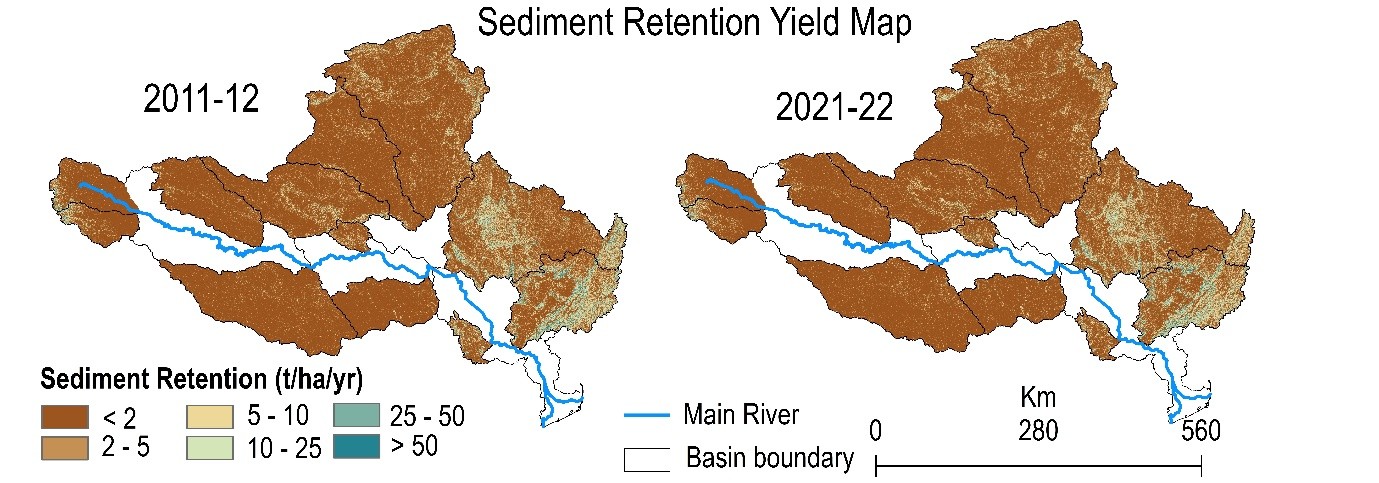
Spatial patterns of sediment retention yield across major sub-basins in Godavari Basin for 2011–12 and 2021–22. The maps depict basin-wide variations and highlight temporal changes in sediment dynamics between the two periods
Detailed methodology and results can be found : Kantharajan, G., Govindakrishnan, P.M., Singh, R.K., Singh, A., Satyaveer, Chandran, R., Tyagi, L.K., Sarkar, U.K. and Rana, J.C., 2026. Prioritising tropical river sub-basins using a geospatial sediment export index for aquatic ecosystem management. Discover Geoscience, 4(1), p.112.
https://doi.org/10.1007/s44288-026-00467-9